[VIDEO] Motor Trend’s Epic Comparison of the Corvette Stingray, Porsche 911 Carrera 4S and the Ferrari F12

[VIDEO] Motor Trend Epic Comparison of the Corvette Stingray, Porsche 911 Carrera 4S and the Ferrari F12

Motor Trend wasn’t able to get a couple of the newest supercars – the 2014 Corvette Stingray Z51 and the Ferrari F12 – for its annual Best Driver’s Car contest earlier this year, when the Porsche 911 Carrera 4S took the title again for the second straight year.

Fortunately, the magazine was finally able to procure samples of the Stingray and the F12 Berlinetta and put the two masterpieces through the paces against the 911 in a mini-sampling of three of the world’s best cars.

Since there was such a wide gap in the prices, said Motor Trend, “we decided the only fair way to approach this comparison test would be to apply a version of our Best Driver’s Car rules. Metrics like value and design get flung out the proverbial window in favor of how great the car is to drive on the highway, a back-country twisty road, and, of course, our home away from home, Mazda Raceway Laguna Seca.

We’ll go ahead and tell you that they judged the Porsche to be tops again, but don’t think the Corvette wasn’t able to make the 911 sweat it out.

[VIDEO] Motor Trend Epic Comparision of the Corvette Stingray, Porsche 911 Carrera 4S and the Ferrari F12

“For the first time in my professional career, I can honestly say that a new Corvette is a complete package,” Motor Trend’s Jonny Lieberman concluded. “There’s nothing anywhere to betray America’s favorite sports car. Stuff like crap seats, crappier interior, and an indismissible feeling of cheapness have been banished to the dustbin of automotive history. The new Corvette absolutely rocks.”

In fact, Lieberman says that at Laguna Seca, he found the Stingray “nearly as planted as the 911. That said, I believe the 991 iteration of the 911 has the best suspension damping in the history of the production car.”

We all know that Chevy’s engineers aimed at making the C7 better than the 911. Their efforts paid off, according to Lieberman. “The RWD Corvette puts its power down to the ground as well as the AWD 911 does,” he wrote. “Big props to the guys who perfected that trick sport differential – it’s close to magic.”

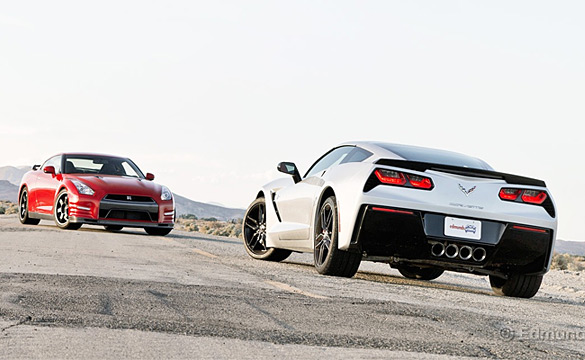
Looking at the stats, it’s hard to believe that the Stingray is even being compared to the Porsche and Ferrari, considering that the former sticks for $151,260 and the latter for a whopping $434,144.

“If we were to compare the C7 with the 911 in a contest where money mattered, it would be hard to ignore the fact that the Porsche costs twice what the Chevy does,”

Lieberman admits. “Really, really hard.”

Check out the video to see the three cars in action…

Source:
Motor Trend

Related:
[VIDEO] Motor Trend Dyno’s the 2014 Corvette Stingray
[VIDEO] Justin Bell Drives the 2014 Corvette Stingray at Laguna Seca
[VIDEO] Motor Trend Tests the 2014 Corvette Stingray Z51
 

Edmunds Tests the C7 Corvette Stingray vs 2013 BMW M3 Coupe

Edmunds Tests the C7 Corvette Stingray vs 2013 BMW M3 Coupe

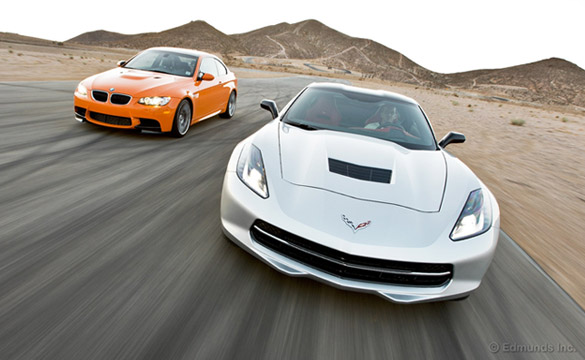
Edmunds.com continues its series of road tests pitting the 2014 Corvette Stingray up against some of the world’s best cars. This week, they’re comparing Chevy’s sports car to the 2013 BMW M3, which after a long run is making its farewell journey into the world of used performance cars.

Numbers-wise, Edmunds reports the obvious. The Stingray is head and shoulders above the M3 when it comes to things like overall performance. For example, the Corvette whips the BMW in lap time at the Streets of Willow, 1:24.55 to 1:29.02. The Stingray is 6/10ths of a second faster in the quarter mile, 12.4 seconds to 13.0, and the same amount faster going 0 to 60, 4.3 seconds to 4.9. The skidpad test likewise places the Chevy at the top, pulling 1.05g to the BMW’s 0.93. The C7 also has better brakes, stopping five feet sooner from 60mph and running through the slalom at 73.5mph to the M3′s 70.3.

Test drivers loved the Corvette. Witness the praise Josh Jacquot heaped on the Stingray after his run around the Streets of Willow. “What an instrument,” he gushed. “There’s no need to qualify the Corvette’s performance now. It lacks bad manners. It’s fast. It makes the right sounds. It turns, stops and goes like crazy. It’s predictable, reliable and world class in virtually every way. Remarkably easy to place. Confident. Communicative.”

The Corvette’s high-tech magic also impressed the Edmunds’ drivers, with the Performance Traction Management (PTM) drawing praise for its astounding grip as did the electronic limited-slip and the Michelin Pilot Super Sports tires. Then there is the active rev matching that makes shifting the seven-speed manual an easy task for anyone.

And before you think the Stingray, with its state-of-the-art gadgetry, is guilty of the kind of video game critiques aimed at the Nissan GT-R, Edmunds says “Chevrolet’s finest is still a hugely visceral and exciting car.”

Ironically, though, all this high-tech magic on the Corvette led Edmunds to claim that the M3 “actually proved to be the more memorable drive, leaving us feeling more accomplished and hungry for more.”

And we continue to see the automotive media world still holding a grudge against the Corvette’s interior, even though it’s been tremendously upgraded.

Edmunds almost seems to begrudge saying the following: “There is reason to praise the Corvette’s cabin. The quality of materials and construction is indeed reflective of its price and performance, and with the LT3′s extended leather package, it certainly looks more dramatic than the M3. However, the BMW is without question built to a higher standard. The gap between the two has been reduced monumentally, but it remains.”

In the end, Edmunds says the Corvette is entirely doable as a daily driver – “However, we would still rather have an M3 for such duty,” they conclude.

Edmunds does admit that there’s “absolutely no denying” that the new C7 is “the performance champion here and ultimately the better weekend plaything or extra car in the garage. That’s what most people in this segment want, and the Corvette delivers in ways the M3 can’t match.”

But if you have room for only one car, Edmunds continues, the M3 is “an impeccably crafted, reasonably practical, sufficiently comfortable daily plaything with the ceaseless ability to thrill on roads both twisting and mundane. Farewell, friend. We’ll miss you.”

Source:
Edmunds.com

Related:
Edmunds Track Tests the 2014 Corvette Stingray vs the 2013 Porsche 911
Edmunds Compares 2014 Chevy Corvette Stingray Z51 vs. 2014 Nissan GT-R Track Edition
Edmunds Track Tests the 2014 Corvette Stingray vs the 2013 SRT Viper


Edmunds Track Tests the 2014 Corvette Stingray vs the 2013 Porsche 911

Edmunds Track Tests the 2014 Corvette Stingray vs the 2013 Porsche 911

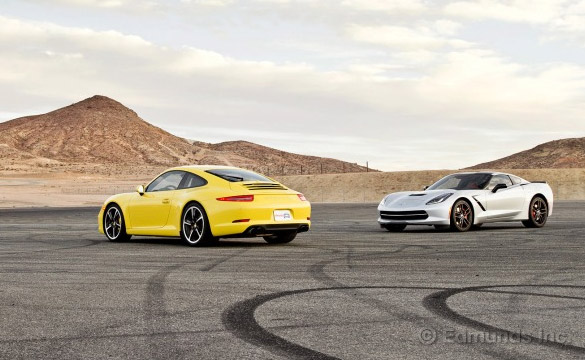
Chevrolet’s C7 development team made no secret all along of the car they were targeting with the 2014 Corvette Stingray.

In fact, the Porsche 911 was the only car that the engineering team bought as a benchmark for the Corvette.

After taking wins over the SRT Viper and the Nissan GT-R in head-to-head testing by Edmunds.com, the Stingray finally met its match in the 911, Edmunds ruled.

However, the Corvette did emerge as tops in a number of categories, but what a price nearly double the Stingray’s can add in “little things” proved to be the winning difference for the 911.

What you can gather from the Edmunds test is that both of these cars are great.

The Corvette, for example, was the leader in torque, with an advantage of 140 pound-feet that come 1,000 RPM sooner, and in horsepower, with a 460 to 400 lead.

Yet the Porsche’s outstanding launch control enabled it to take a win in acceleration testing, both 0 to 60 and in the quarter-mile.

The Corvette bounced back in handling tests, though, with a slalom pass nearly 3 mph better than the 911 and a narrow win on the skid pad (1.05g to 1.04g), and also stopped faster, 99 feet vs. 101 feet going 60 to 0.

“…It’s here, on the track, that the Stingray shows its real merit,” Edmunds writes. “Motivated by what is fundamentally a truck engine, it finds speed in places the 911 doesn’t. Largely, it’s the Stingray’s ability to explode away from an apex that earns it the advantage.

Performance Traction Management is deadly effective in making the laps both fast and easy.”

The Stingray also earned loud applause for its steering feel and response, with Edmunds saying “there’s a confidence in the C7’s steering beyond that of most every other sports car made today. Its front end sticks with intractable persistence.”

Not to say the Porsche is a slouch behind the wheel, though.

Writes Edmunds: “The 911, for its part, remains an amazing car to drive hard. Its light but direct steering makes no concessions when driven at speed. Its brakes are so utterly capable that we began to think they’re actually worth the cost of a nice sport bike. Its balance, communication and honesty at the limit are remarkable.”

Still, the Stingray managed a 1-second win in the best time around the 1.6-mile Streets of Willows Springs road course.

And get ready for this, the 911 still has the better interior, Edmunds believes. “Chevy moved mountains in improving the Corvette’s interior, but there’s still a vast gap between these cars in quality,” they say. “Everything you touch in the 911 is laser-micrometer precise and right-now responsive. The differences matter. In the 911 you move and it moves with you. In the Stingray you punch the touchscreen twice and wait. You step cleanly into the 911. You descend into, over and around the Corvette. And on a hot day, the 911 smells like leather. The Corvette smells like chemicals.”

So did Chevy achieve its goals going up against the 911?

Edmunds believes overall, it did. “Picking the ‘Vette is the obvious choice since it’s supported by ample empirical data. At the end of the day, we can’t deny that the home team nailed at least one of its primary targets. Making the Corvette as quick and rewarding as a 911 is a big task, and it’s been fully accomplished. The Corvette, when driven hard, is as good as the 911, maybe better. There, we said it.”

But hold on a minute.

“But then there’s the undeniable reality that the 911 is the better car,” Edmunds says. “Whether we’re taking our kids to school or adding subtle countersteer to correct that big slide, we’d rather have the Porsche. It’s the car that wins our hearts so it’s the car that wins this test.”

Source:
Edmunds

Related:
Edmunds Compares 2014 Chevy Corvette Stingray Z51 vs. 2014 Nissan GT-R Track Edition
Edmunds Track Tests the 2014 Corvette Stingray vs the 2013 SRT Viper
[VIDEO] 2014 Chevrolet Corvette Stingray: 48 Hours with the C7 in Detroit


Edmunds Compares 2014 Chevy Corvette Stingray Z51 vs. 2014 Nissan GT-R Track Edition

Edmunds Compares 2014 Chevy Corvette Stingray Z51 vs. 2014 Nissan GT-R Track Edition

Chalk up another victim for the 2014 Corvette Stingray.

Edmunds.com recently pitted Chevy’s latest generation of America’s Sports Car against the 2014 Nissan GT-R Track Edition.

Based on numbers alone, the Corvette shouldn’t have won this shootout of macho sports cars. For instance, the Stingray was giving up 85 horsepower to the GT-R, and the Nissan was priced nearly $50,000 higher than the Corvette.

In the end, though, it didn’t matter as Edmunds gave the nod to the Stingray.

“We expected this one to be close. It wasn’t,” they wrote.

“Though it smoked the Corvette in acceleration and in the slalom and offers a better interior, it didn’t matter if we were at the track, in a canyon or just driving home; the GT-R simply isn’t as exciting as the ‘Vette.”

Edmunds especially praised the Stingray’s steering, calling it “outstanding: quick and hyper-pointy with solid feel and precision.” They also said it wasn’t just “Corvette good” or “electric steering good,” – “it’s no-qualifier exemplary.”

The Z51′s Magnetic Selective Ride Control and its multiple drive modes also impressed Edmunds.

“Select Touring mode and the C7 rides with all the confidence and composure of a Cadillac,” Edmunds writes. “Flick the knob over to Track and it’s a tail-happy terrier without a millimeter of slack. You won’t find that flexibility in the GT-R.”

Without the first consumer-driven car on the road, the Stingray has already taken over the realm once occupied by the GT-R, according to Edmunds.

“When the Nissan GT-R first showed up on the scene, it occupied a unique position. Nothing offered similar performance, technology, refinement and badassery at the GT-R’s price. Not even close. That domain now belongs to the Stingray. Nothing offers this much refinement, power, performance, tech and driver involvement at this price.”

Perhaps most telling – and satisfying to Corvette fans – is Edmunds’ supposition that GT-R doesn’t lose the challenge to the Corvette because it’s not $47,020 better than the Stingray.

“It loses because it’s not better than the Corvette, period,” Edmunds says.

Source:
Edmunds.com

Related:
Edmunds Track Tests the 2014 Corvette Stingray vs the 2013 SRT Viper
Will Future Corvettes Get Stop-Start Technology?
[VIDEO] Edmunds Drives the 2014 Chevrolet Corvette Stingray


Edmunds Track Tests the 2014 Corvette Stingray vs the 2013 SRT Viper

Edmunds Track Tests the 2014 Corvette Stingray vs the 2013 SRT Viper
Photo Credit: Edmunds.com

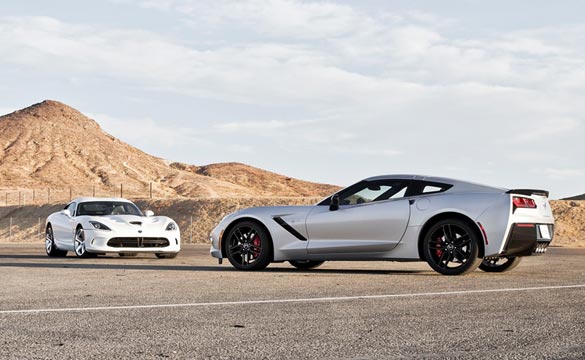
We knew it was coming – this battle between the 2013 Viper and the long-awaited 2014 Corvette Stingray.

Edmunds.com quite simply labels it the “Best. War. Ever.” Few would argue.

And (spoiler alert) while Edmunds, in the end, gives the nod to the latest-generation Corvette, it admits that the Viper is a very, very special car, despite its shortcomings.

“Because of its much lower price, manners that are easy to live with in daily use and still astonishing performance, the Corvette takes a narrow win here,” Edmunds proclaims. “It is the one car you can drive comfortably every day and still use to dominate a track day. Built around an impregnable structure, overstuffed with technology that actually improves the driving experience, and so easygoing you can commute in it with one finger on the wheel, it’s this year’s great leap forward for the entire breed of sports cars.”

The Stingray takes a moral victory in performance results because it gives up 180 horses and 135 lb-ft in torque to the Viper, yet GM’s latest creation managed to be less than a second behind the Viper around the 1.6-mile Willow Springs course.

“During development the Chrysler and GM engineers were aiming at very different, very specific things with these cars,” Edmunds writes. “And all that is apparent even before anyone puts them into gear.”

Here’s what they had to say about the C7, calling it a “two-seater that doesn’t scrimp on comfort. It’s quiet but makes a great sound when the engine is working. Pick the right suspension setting and it rides over freeways better than some Cadillacs, and what is ferociously precise steering on track mellows into easygoing operation during commutes. In some significant ways (suspension compliance and steering feel in particular) the Corvette is easier to live with than a Malibu. It’s that easy and that good.”

Meanwhile, Edmunds says the Viper “is actually oddly wonderful on the street. This isn’t the sort of car you take through the drive-through or to Home Depot to pick up bathroom fixtures. Sure, you can drive it every day if you really want to, but this is a special event car; every time it’s on the road it’s a one-car parade. It’s a car that feels alive from the heft of the shifter to the heat from its side exhaust. This car doesn’t take you for a ride, it demands you pay attention and get involved in the driving experience. You want cushy comfort, buy a Charger. It’s right next to the Viper on the showroom floor.”

Maybe it’s a great day to be an American when we can have two supercars made in this nation, huh?

Read Edmunds’ complete report by clicking here.

Source:
Edmunds.com

Related:
The Corvette Stingray Marketing Plan Will Target Wives and Highlight ‘Luxury’ in Advertisements
GM Testing the C7 Corvette Stingray Against Ferrari, Porsche and Audi
[VIDEO] MotorTend Head 2 Head: SRT Viper GTS vs Chevrolet Corvette ZR1